How many restrooms does a county fair need?
Fair attendance is lumpy. It's dead at 10am and slammed at 2pm, so you plan for the peak hour, not the daily average. Our guide on how many porta potties you need walks through headcount math, but for a multi-day fair in Fort Collins, we usually start with one standard unit per 75 to 100 attendees at peak, then add units near food vendors and grandstands where lines form fast. ANSI/PSAI Z4.3 sets a baseline service interval of once per week for up to 10 users over a 40 hour stretch, which tells you why a three-day fair with thousands of guests needs a servicing plan built for the event, not the standard weekly swing. We also fold in handwashing station rentals near food booths, because a fair without them is a fair with a line at the one working sink. If your event includes livestock exhibits or 4-H barns, treat that area as its own zone. Ag areas draw a different crowd pattern than the midway, and Fort Collins fairgrounds often run both simultaneously. For layout advice on where units actually belong relative to foot traffic and tent lines, see our porta potty placement guide. We can also mix in a deluxe flushable unit or two near VIP or sponsor areas if the event calls for a step up from standard.
What restroom options work best for a fairground?
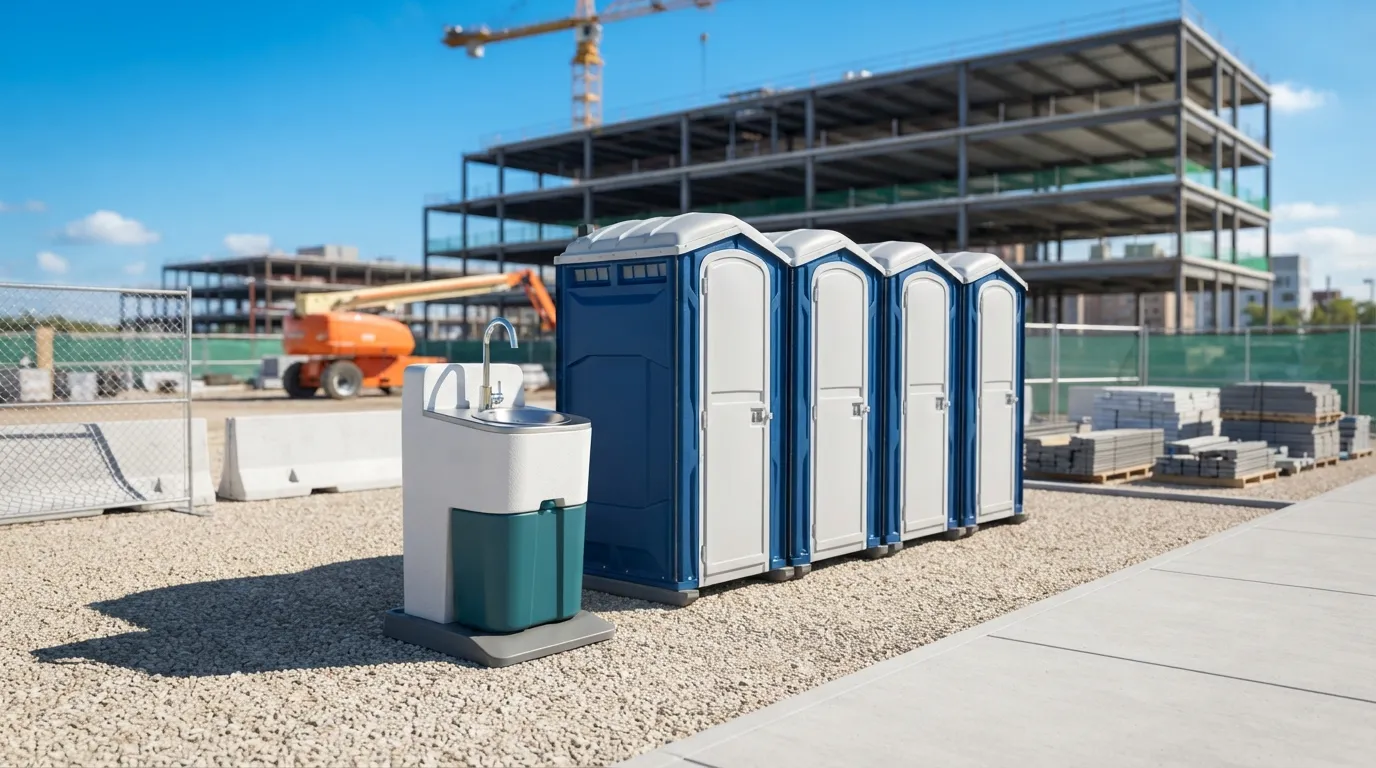
Most fairs run a mix: standard units for general crowd flow, ADA-compliant units required under ADA Standards section 213.2, which mandates that at least 5 percent of any cluster of single-user units, and never fewer than one, be accessible. A standard unit sits about 44 by 48 inches on the ground and stands roughly 92 inches tall, so plan clearances accordingly when spacing them along a fence line or near bleachers. For fairs expecting heavier turnout or wanting a nicer experience near a beer garden or main stage, an 8 stall restroom trailer or 4 stall restroom trailer handles volume without the line buildup you get from single units. Trailers need a level pad and, depending on model, a hookup, so we scout the site ahead of delivery. Delivery itself needs planning too. Roll-off and trailer deliveries typically need about 60 feet of straight clearance behind the truck, which matters on a fairground with parked vendor trailers and temp fencing already in place. Below is a rough breakdown of what fits which crowd size.
| unit type | best for | typical rate |
|---|---|---|
| standard | general midway crowds | 125 to 400 per weekend |
| ada | required accessible coverage | 199 to 300 per weekend |
| deluxe | VIP or sponsor zones | 150 to 290 per week |
| restroom trailer | grandstand, beer garden | 900 to 3,000 per weekend |
We also handle the supporting pieces: temporary fencing around restroom clusters or livestock pens, storage containers for fair staff gear, and roll-off dumpsters for teardown once the gates close. A lot of fair organizers underestimate trash volume until Sunday night, so we size dumpsters against expected daily waste, not just the final total.
Do we need permits for fairground restrooms in Fort Collins?
Placement on fairground property usually falls under the venue's own rules rather than a public right-of-way permit, but that still needs confirming with the city before you finalize a site plan. We don't guess on this. If your event footprint touches public streets or sidewalks for staging or parking, check with the city on placement requirements before delivery day, and see our porta potty permit requirements page for what that conversation usually covers. Worker sanitation for fair staff and vendors, separate from public-facing units, falls under OSHA 1926.51(c), which sets toilet counts based on crew size. If any fair staff are mixing herbicides for grounds work or applying coatings to booths or structures, OSHA 1926.51(f)(1) requires washing facilities for that specific task. Most fairs in Fort Collins run adjacent to Loveland, 10.6 miles south, or Timnath, 8.4 miles east, and we service both alongside the main event site without a separate mobilization charge in most cases. For general event sanitation planning beyond just the fair, our event restroom rental and festival restroom rental pages cover similar crowd-based logic.
How far in advance should we book fairground restrooms?
Book as soon as your date and expected headcount are set, ideally 60 to 90 days out for a multi-day fair. Fairground rentals compete with wedding season and construction demand in Fort Collins, and restroom trailers book out fastest. Waiting until two weeks out limits your options to whatever standard units remain.
Can we get restrooms for just the livestock or 4-H area?
Yes. Ag zones often need separate service from the midway, since foot traffic and hours differ. We treat barns and show rings as their own cluster, sized by exhibitor and volunteer count, and can service that area on a different schedule than the main fairground restrooms.
What happens if the fair extends past our contracted days?
Call ahead of your end date if attendance or weather pushes the event longer. We can usually extend a weekend rental at the daily rate rather than force a full new booking, but that depends on unit availability for the following event on our schedule.
Do you provide handwashing stations separate from the restrooms?
Yes. Food vendor rows and livestock areas need their own handwashing setup under 29 CFR 1910.141(d)(2), which requires soap and towels or a drying device, not sanitizer alone. We place these stations independent of restroom units, closer to food booths and animal contact points.
How do you handle servicing during a three-day fair?
We build a servicing schedule around your daily attendance curve, not a flat once-a-week visit. High-traffic fairs typically get serviced once per day or more, timed for early morning before gates open so units are clean for the day's peak crowd.
Next step
Get a delivery date
Tell us the address, the dates and the headcount. We size the order and confirm the route.